Thermal Cleaning from Tooling and Components
Fluidized baths are a safe and powerful method for removing polymers, lacquer, epoxy, coatings, greases, resins and plastic residues from tooling and production parts.
Advantages of thermal cleaning:
- Faster than traditional ovens or chemicals
- Completely chemical-free: no solvents, no corrosion, no fumes
- Temperature is perfectly controlled and uniform
- Suitable for complex geometries and small bores
- Aluminum oxide is inert and safe to use
Commonly used applications:
cleaning extrusion dies
injection molding tools
filters, nozzles and tooling
medical instruments
maintenance in plastics, automotive and packaging industries
Heat Treatment from Metals and Materials
Fluidized baths provide the temperature uniformity and stability necessary for high-quality heat treatment. With temperature ranges from –100°C to +1100°C, the systems are suitable for almost all heat processes.
Applications:
- glowing (annealing)
- temper
- harden
- low-tension annealing (stress relief)
- high temperature molding
- thermal stability tests
- the uniform heat distribution
Prevents hot spots and ensures consistent process results — essential for precision parts in medical and industrial applications.
Nitinol Shape Setting & Medical Components
In the medical industry, precise shaping of Nitinol (nickel-titanium) is crucial. Fluidized baths are ideal for this because of their:
- extremely stable temperature
- fast heat transfer
- inert medium (no contamination)
- reproducible results
Typical applications:
design of Nitinol stents
orthodontic components
medical guidewires
surgical instruments
Stainless steel assemblies for medical equipment
Fluidized baths offer much better control than ovens, salt baths and convection systems.
Reactorheating for Endotherm and Exotherm Processes
Fluidized baths are used worldwide for the safe and accurate heating of:
- reactor vessels
- spiral reactor coils
- biomass reactors
- jacketed reactors
- Parr reactors
- Laboratory reactors
Advantages for reactor heating:
- high heat transfer → shorter reaction times
- uniform temperature distribution
- safe, because aluminum oxide is inert
- ideal for critical chemical processes
Additive Manufacturing, Extrusion and Plastics Industry
Fluidized baths solve problems that are essential for plastic and AM production processes:
- removing polymers from 3D print heads
- cleaning extrusion dies
- heating of tooling during production
- preparatory heat treatment of metal powder parts
- testing components at high temperatures
Their stability makes them ideal for production environments where accuracy and repeatability are key.

The technology
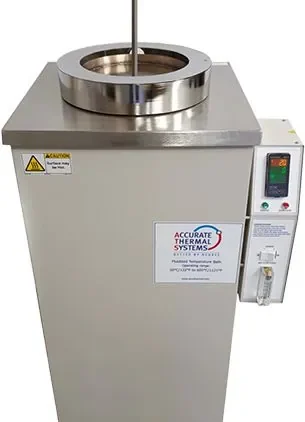
Fluidized bath technology has been used in a variety of industrial processes for more than fifty years. A fluidized bath consists of a tank or inner container with an air chamber at the bottom and a porous plate at the top. The tank is filled with aluminum oxide media, after which compressed air is blown into the air chamber under sufficient pressure and flow. This creates air bubbles that move through the aluminum oxide and break the surface.
The heat is introduced directly or indirectly into the medium via the heating system. The constant air flow continuously mixes and agitates the heated alumina, creating a stable, uniform and perfectly controlled temperature environment. The “bubbling” behavior of the aluminum oxide gives the medium thermal properties similar to those of a liquid — hence the term fluidization. The difference: a fluidized bath can reach much higher temperatures than liquid media, which is essential for industrial cleaning, heat treatment and calibration processes.
These liquid-like properties ensure fast, direct heat transfer and significantly shorter heating times of submerged objects.
Inert, safe and non-abrasive aluminum oxide
The aluminum oxide Accurate Thermal Systems uses is inert, safe and non-abrasive, making it suitable for sensitive parts. The particle size (120 grit) is large enough not to adhere to objects: once a part is removed from the bath, the aluminum oxide simply falls from the surface or can be removed with compressed air.
A fluidized bath is not a grit blasting system or sand blaster; the aluminum oxide does not cause wear or damage. Organic materials such as polymers, oil, resin or coatings are completely thermally decomposed by the controlled, gentle bubbling action of the fluidization process.
This combination of safety, uniformity and speed makes fluidized baths an ideal solution for thermal cleaning, heat treatment, Nitinol processing, sensor calibration and industrial temperature applications.
Removal using a fluidized bath
This short video clearly shows how a fluidized bath works and how it effectively thermally cleans tooling. In this example, HDPE is removed, but our fluidized baths can remove virtually all types of organic material, including: plastics, lacquer, paint, resin, glue, epoxy, oil, silicone, rubber, grease, food residues and plant products.
Fluidized baths offer a fast, safe and efficient cleaning method for parts from extrusion and injection molding processes. Unlike grit or media blasting systems, the material is not removed mechanically, but thermally burned without damaging the metal.
Applications: What can you clean?
Our fluidized baths are used for cleaning, among other things:
- hardware and mounting materials
- pressure transducers
- melt flow indexer dies
- capillary rheometer parts
- crossheads and adapters
- screen packs
- extrusion profiles
- screw elements
- molds
- countless other industrial tooling parts
Thanks to the liquid-like movement of the aluminum oxide, the insides of hollow or assembled tooling are also completely cleaned.
Efficient and fast: clean in 30–60 minutes
Thermal cleaning typically takes 30 to 60 minutes, depending on the material and contamination. A short cleaning cycle means less downtime for maintenance or line changes.
After placing the part in the bath, no operation or supervision is required, so operators can continue with other activities.
Fluidized baths are four to five times faster than pyrolysis ovens, burn-off ovens or other thermal ovens, and use significantly less energy.
Unlike ultrasonic cleaning or chemical purges, no hazardous chemicals are required.
Safe and environmentally friendly cleaning
During the process, organic material is completely thermally decomposed. Any emissions can be removed via the existing factory exhaust or completely eliminated with one of our HEPA air filtration systems or thermal incinerators.
The broken down residues are absorbed into the aluminum oxide as carbon. Used aluminum oxide can be disposed of as regular waste because it is inert and non-hazardous.
Prevents damage to tooling
Where ovens, burners or manual cleaning often lead to overheating, deformation or damage, a fluidized bath delivers:
stable, uniform temperature
no hotspots
no thermal shock
no risk of tooling bending
complete cleaning deep into internal channels
This makes the technique ideal for precision tools and critical production parts.
Recommended A.T.S. models for thermal cleaning
For industrial cleaning applications we recommend the following Accurate Thermal Systems models:
FTBSL6, FTBLL12, FTBLL12W, FTBLL26, FTBLL27 and FTBLL47.
These systems provide the optimal capacity, temperature stability and efficiency for both small and large production environments.