Thermal Cleaning of Tools and Hardware
What is Thermal Cleaning?
Thermal cleaning is a highly effective high-temperature process used to remove polymers, coatings, oils, greases and carbonised residues from industrial tooling and components—completely without chemicals.
Using a bed of fluidized aluminium oxide, an A.T.S. fluidized bath delivers fast, uniform and precisely controlled heat transfer, ensuring even the most persistent contamination is fully decomposed.
A.T.S. thermal cleaning systems are used throughout Europe in plastics processing, extrusion, medical device manufacturing, automotive engineering and general metalworking.
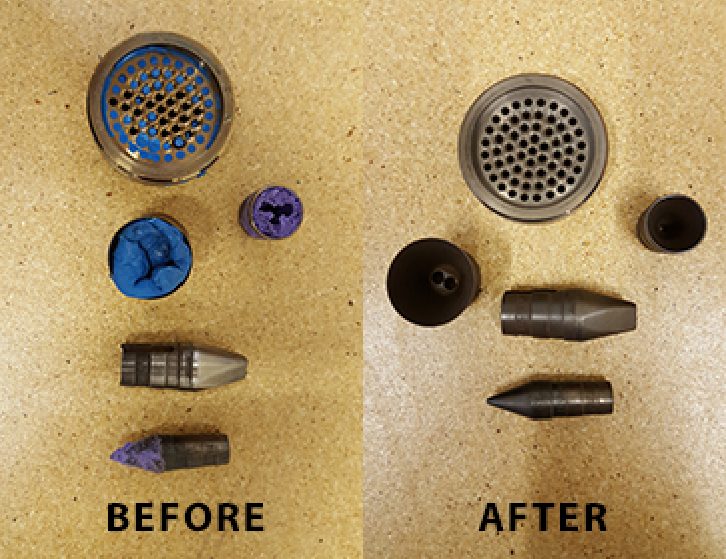
How a Fluidized Bath Removes Coatings and Residues
A fluidized bath uses a bed of aluminium oxide that behaves like a homogeneous liquid layer when activated by airflow.
Heated air is forced upward through the media, creating a fluidized state that fully surrounds the component. This produces exceptional temperature uniformity and allows all organic material to be thermally decomposed into fine, inert ash.
There is no thermal shock, no hotspots and no open flame—only controlled high-temperature cleaning with maximum safety for the component.
Why Choose A.T.S. for Thermal Cleaning
High-Temperature Cleaning Without Chemicals
Thermal cleaning eliminates the need for solvents or corrosive stripping agents. The fluidized aluminium oxide bed ensures stable, uniform and controlled heat transfer, breaking down polymers, oils, coatings and carbonised residues safely and efficiently.
Used across Europe, A.T.S. thermal cleaning solutions provide a reliable, environmentally compliant alternative for plastics, extrusion, medical, automotive and metalworking industries.
Typical Industrial Applications
Plastics & Extrusion Tooling
Thermal cleaning is particularly effective for maintaining plastics and extrusion tooling, where polymers, carbon buildup and process residues accumulate rapidly.
Components such as dies, breaker plates, nozzles, extrusion heads and filters often contain narrow channels that are difficult to clean mechanically or chemically.
A.T.S. fluidized baths remove organic contamination uniformly without damaging the base material. This ensures stable product quality, consistent flow behaviour and reduced downtime. European plastics processors rely on thermal cleaning to reduce scrap and keep extrusion lines running efficiently.
Medical Device Components
In the medical sector, absolute cleanliness is essential. Thermal cleaning removes polymers, coatings, binders and processing residues without chemical traces and without deforming the part.
Typical components include Nitinol mandrels, microtubes, surgical instruments, catheters and fine wire assemblies.
The controlled, uniform heat prevents micro-damage, ensures biocompatibility and meets the strict requirements of European medical OEMs and suppliers.
Automotive Components & Assemblies
Automotive parts often contain oils, greases, combustion residues and coatings that must be removed completely for service or remanufacturing.
Chemical stripping, pyrolysis or abrasive blasting can deform components or leave contaminants behind.
A.T.S. fluidized baths deliver clean, uniform and repeatable results for injector housings, turbo components, valve bodies, tooling and metal assemblies.
Contamination is fully decomposed without affecting tolerances, extending tool life and reducing maintenance cycles across automotive production and remanufacturing.
Metalworking & Coating Removal
Metalworking processes often require the removal of powder coatings, epoxy, polymers, lubricants and protective layers—without damaging the metal.
A fluidized bath prevents distortion, oxidation and abrasive wear, making it ideal for cutting tools, dies, precision-machined components and coated metal parts.
For European manufacturers, thermal cleaning provides a predictable, durable and safe method of coating removal.
Additive Manufacturing (AM) Components
3D-printed parts frequently contain internal structures, cavities and complex geometries where support material becomes trapped. These are difficult to remove mechanically, chemically or with conventional ovens.
A.T.S. fluidized baths behave like a uniform, high-conductivity “liquid” heating medium, allowing complex AM components to be heated evenly. Support materials and polymers are safely decomposed without deformation.
Suitable for metal and polymer AM, including powder-bed fusion, FDM, binder jetting and more. The result: cleaner parts and significantly reduced post-processing time.
How the A.T.S. Thermal Cleaning Process Works
Fluidized Aluminium-Oxide Media
A.T.S. systems use a specially selected aluminium-oxide medium that becomes fluidized when a controlled stream of compressed air is passed through it.
The solid particles behave like a vigorously stirred liquid, moving freely around the submerged component.
Unlike traditional ovens—where heat circulates unevenly—fluidized media ensures complete contact with every surface, even in internal channels and complex shapes.
This provides exceptional process control, superior uniformity and extremely stable temperatures, ideal for precision cleaning.
Rapid Heat Transfer & Uniform Temperature
One of the main advantages of a fluidized bath is its extremely fast and uniform heat transfer.
Aluminium-oxide particles have high thermal mass and conduct heat far more efficiently than air in a conventional oven.
Because the media behaves like a liquid, every point on the component receives the same level of heat—without hotspots or cold zones.
This results in short cycle times and reliable, repeatable cleaning performance.
Such thermal uniformity is critical when dimensional stability and material integrity must be preserved.
Complete Removal of Carbon, Polymers & Oils
The high temperature and uniform heat distribution ensure complete decomposition of all organic materials.
Polymers, oils, adhesives, coatings, varnishes and carbon residues are converted into a small amount of inert ash.
Because even narrow bores and internal geometries are reached, the cleaning is significantly more effective than chemical baths or pyrolysis ovens.
Components exit clean, residue-free and ready for use or further processing.
This level of cleaning performance extends tool life, reduces scrap and minimises downtime—making it a preferred method across extrusion, automotive, medical and AM industries.
Advantages of Fluidized Baths for European Manufacturers
No Solvents or Chemical Baths
Thermal cleaning eliminates the need for hazardous liquids, corrosive chemicals or solvent disposal procedures.
This results in a safer, cleaner and more sustainable process that complies with strict European environmental and safety standards.
Reduced Maintenance Downtime
A.T.S. fluidized baths heat up quickly and clean far faster than ovens or chemical baths.
Tooling can be cleaned, reassembled and returned to production rapidly—reducing downtime and increasing productivity.
Predictable and Repeatable Results
The consistent thermal behaviour of a fluidized bath delivers the same result every cycle, independent of part geometry or contamination level.
This reliability is essential for sectors requiring strict process control, such as medical, automotive and aerospace.
Compatible with All Common Tooling Materials
Thermal cleaning is suitable for steel, stainless steel, hardened tool steel, aluminium, titanium and high-performance alloys.
Uniform heating prevents distortion or thermal shock, preserving geometry and surface quality.